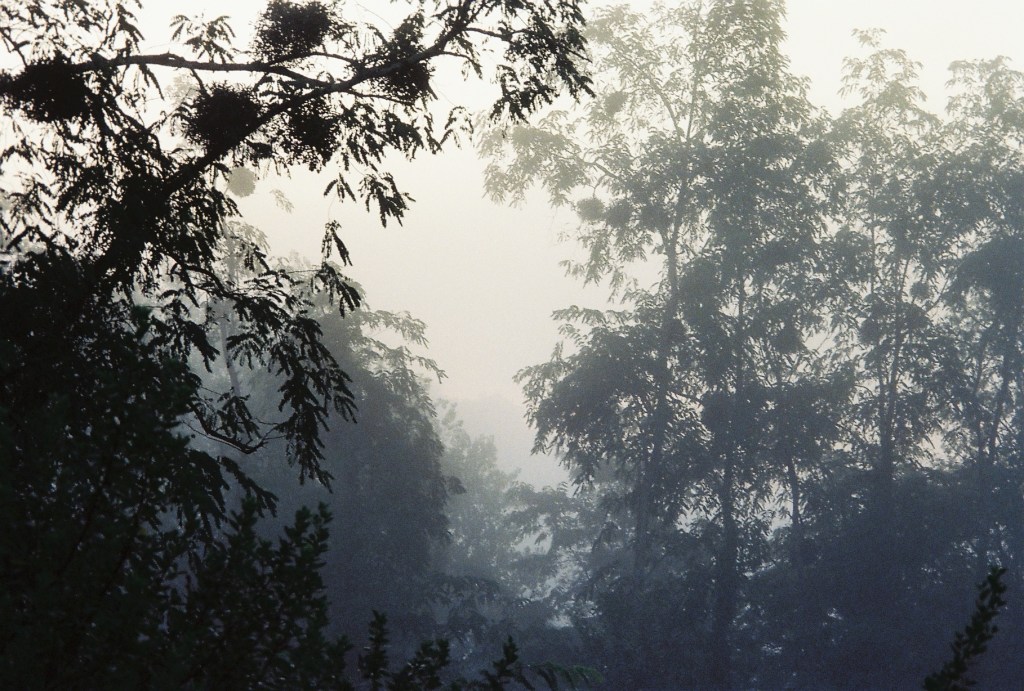
How do change and stagnation exist in the same space? How does the lack of external intellectual stimulation, kill your own intellectual curiosity?
There is only so much you can achieve on your own. Your own imagination is a variation, a beautiful creative mirror, a mix, of our external and internal world. Neither one can exist without the other, for the absence of comparison between two entities, erases the existence of the one which cannot be compared? I do not state this, I question it.
Our worlds are constructed so carefully upon the things we know, think, desire and feel, but those things cannot exist by themselves. There are causes and there are consequences, in simply terms, it’s the law of cause and effect. That means that whatever we are, whatever our reactions are, sits somewhere in between those two. Something happens, you feel a certain way because of it, and then you react a certain way to it. Isn’t that how everything in life works?
Therefore, by absence of external stimuli, there is an absence of feeling, which equals a lack of reaction. With no reaction, nothing external changes, just as nothing internal happens; it’s a chain. In this manner of seeing things, I mean creatively or productively, the chain can go up, and the chain can go down. Once things stop, whether internal or external, it is difficult to get things started again. Just like with productivity, which seems to topple one thing after another onto each other, making you even more productive, this can happen on the reverse of the coin. Things start to slow, and as you stop doing the thing, stop writing, stop questioning, stop listening… they naturally come to a halt. Cause and effect means that you stop doing those things internally, and the external world no longer wakens those things within you. Stagnation at this point, is difficult to change.
When things come to a halt in this way, the question is, did you stop because of internal or external stimuli? Which one affects the other on this chain?? Which one is in command, which one drives the other? Maybe a chain is the wrong way of putting it, I think it’s more of a cycle. In this cycle, it is almost impossible to determine which one stopped the other, because the knock on effect is the same, spreading and multiplying to the same extent. There is no control over internal or external factors, because in some way, they are the same thing. The external world is a reflection of your internal world, and yet your internal world is a reflection of the external one. Without one, there is no other, no matter what started what, no matter the reaction to the cause. Does this mean there is no beginning, and no end? If that, then surely without change there would be no stagnation, and no stagnation without change, so one would cancel out the other, meaning the absence of both?
Maybe, neither one is absent, but solely depends on the person on the receiving end. A highly motivated person who is persistant in their efforts, might be impacted by external stagnation, and yet not find that it brings internal movement, dialogue, or change to a halt. I think this depends on a persons focus. The things which you are spending your time doing, what you are thinking about, and who you are surrounded by, might completely alter the external environment, causing an internal reaction, which another person might not have. It would then be solely dependent on the person who passes through, who stagnates within, who reaches for the potential it is subtly offering. What may kill the intellect and curiosity of one, may spike it within another. That I think is where priorities of focus gain all manners of importance. What you choose to see, where you choose to apply your curiosity, your learning, your passion and your persistence, is what will further the development of your internal world, creating room for vaster progression, delivering pathways between the in and the out that nourish each other exponentially.
So, here, it’s about a choice of focus, shifting your consciousness to break patterns of sameness. Maybe nothing is ever plain, nothing is ever blank, nor empty; it all depends on the viewer. The viewer has the power to decide how to interpret, how to react, and how to move forwards. The same goes with art. Once you have finished being the creator, you become the viewer. As the view, you can choose to see the work any way you wish, changing meaning and impact in any way you wish. This does not take away the things that happened, nor the meaning you created, when you were the maker, but as the focus changes, the shift in consciousness and focus gives new birth to something already created. It is basically a recreation, over and over again, as many times as you so desire. New beginning, new creations, can happen in old spaces, in existing works. This cannot happen if you go back to these with the same old patterns. For the external to change, so must the internal. The opposite however may not be true. Things are only condemned to their old patterns if you allow them to stay that way.
I cannot write this without including a part for ‘perception’. In this case, the only one that should matter is our own, although it is never the case. We do not exist without the perception of those around us, because it is through others that we can establish ourselves and our ideas. Remember here, no external, no internal. No matter how difficult thought, our lives, and therefore, importantly, our ego, cannot be defined by the ways in which others see, or imagine, us. Our external world, as others see it, is a way for others to imagine our internal world, although it is entirely skewered and can never be imagined the same from one person to another. What another sees is merely a reflection of their own selves. Again, no external without internal, each one is a cause and effect of the other. We cannot internalise the external, nor can we external the internal. One is the other, and the other is one; and yet, they are just as separate as they are one. Once again, my obsession with dichotomies finds a space here to funnel my argument towards its end. Everything, exists everywhere, all at once (yes just like the film). As usual, we understand that where sadness and joy coexist, so do love and hate, so do fear and bravery, life and death, heat and cold, day and night, awake and asleep, change and stagnation…. There is never one without the other. I think that this is rooted in the universal principal of relationships. Rick Ruben says, in ‘The Creative Act: A Way of Being’, that we can only tell where something is in relation to something else and we can only assess an object or principle if we have something to compare and contrast it too. Wether conscious or unconscious, I think that this is true for everything in life, and it can be good, just as it can be bad. Compare a new artwork to an old one, and you may just have killed its potential. Compare new learning methods to old learning methods, and you will only learn more. You cannot comprehend the existence of one thing without the existence of its opposite. Maybe opposite is the wrong word, but for now, for lack of better one, I hope you understand.
So, overall, and to end what I have now overly dragged out, this goes back to my initial idea, stagnation can exist at the same time as change. When stagnation occurs, and you make a conscious effort to notice it, to focus on it and learn from it, then it becomes its own form and variation of change. Without stagnation, would there be reason for change? The existence of one, pulls in the existence of the other, no matter which way round you look at it. Just as there is no beginning without end, there cannot be change without stagnation, nor the opposite, because they are the same thing. The end of one thing means the beginning of something. The entire of the two, creates one, as they are just as much part of each other as they are of themselves. Without one, there is no other, but in the presence of the two, exists a natural continuity.
 SED Artist
Leave a comment